

Artificial intelligence is playing a growing role in workplace decisions including with who enters an organization and how people progress within it. AI-enabled tools support job advertising, application screening, candidate ranking, interviews, talent identification, succession planning, and decisions about promotion or demotion.
AI tools and systems can help organizations process information at scale and make talent processes more efficient. At the same time, they raise material questions about which criteria influence decisions and whether their effects differ for women and men.
The challenge for organizations is to implement appropriate policies, practices, and processes to govern the use of AI tools and assess their workplace fairness impacts.
AI can shape opportunity before a decision is made

Source: EDGE Certified Foundation, 2026.
There are several key recruitment steps before a hiring manager receives a shortlist. AI tools can influence these, namely who sees a vacancy, how applications are filtered, and which candidates are presented for consideration.
Employment-related AI is already being used for targeted job advertising, application filtering, candidate evaluation, job matching, and ranking. These systems may analyse information such as skills, education, previous experience, and historical hiring data to generate scores or rankings.
The fact that AI can operate at several points in the same recruitment process matters. Small biases may compound across sequential stages. An imbalance introduced when a vacancy is advertised can alter the applicant pool. Screening then determines who moves forward, potentially followed by further AI-assisted assessment. Looking only at the eventual hiring decision may therefore overlook where a difference first emerged.
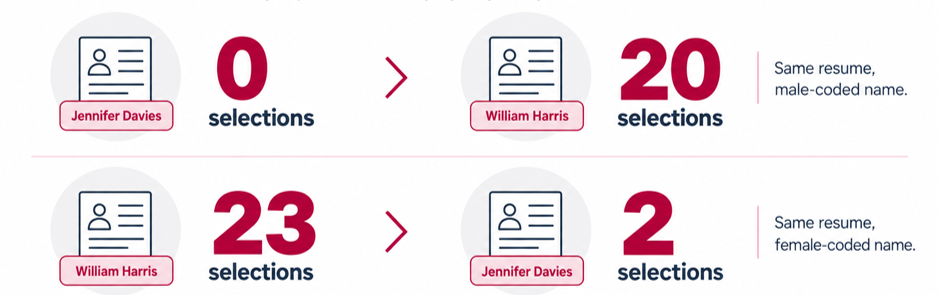
Source: Sivakaminathan, S. S., & Musi, E. (2025). ChatGPT is a gender bias echo-chamber in HR recruitment: an NLP analysis and framework to uncover the language roots of bias. AI & Society.
Research illustrates how gender cues can influence AI-assisted screening outcomes even when the underlying resume remains the same. In a 2025 ChatGPT recruitment experiment, changing only the gender-coded name attached to a resume led to substantial differences in how often candidates were selected, demonstrating how apparently neutral AI-supported processes can produce gender-differentiated outcomes.
When data-driven does not necessarily mean fair and neutral
AI systems depend on the objectives set for them, the data they use, and how they are programmed. In recruitment, this raises a basic question: what does the system actually measure when it identifies a “good” or “strong” candidate?
Historical data can reproduce the same historical patterns. If an AI tool learns from previous hiring or promotion decisions, it may also learn the assumptions that shaped them. Variables that do not explicitly focus on gender can still have gendered effects. Career interruptions, for example, may become a negative signal and disadvantage people who have taken time away from work for caregiving, which we know particularly impacts women. Research on AI-assisted hiring and historical bias highlights how apparently objective criteria can reproduce existing inequalities.
Perceptions of fairness can be reinforced by the “aura of neutrality” surrounding algorithmic recommendations. A score or ranking may appear more objective because it is data-driven, making it less likely to be questioned.
Human involvement therefore needs to exist and needs to be meaningful. If a recruiter or manager receives an AI-generated ranking without understanding what influenced it, or cannot challenge the recommendation, the final human decision is likely to simply reproduce the system’s output.
Promotion and demotion require the same attention
The implications do not end once someone has joined an organization. AI-supported talent management analytics can influence who is identified as having high potential, who enters a succession pool, and who is recommended for advancement.
AI systems used throughout recruitment, evaluation, and promotion can perpetuate historical patterns of discrimination, including against women. The criteria used to identify potential or suitability for progression therefore deserve the same scrutiny as those used to assess external candidates in recruitment processes. This is recognised in the forthcoming EU AI Act.
The same principle applies to demotion. Where AI contributes to a recommendation that an employee move to a lower level, responsibility, or status, organizations need to understand the criteria informing that recommendation and whether outcomes differ for women and men.
What should organizations consider?
We recommend that organizations using AI in recruitment, promotion, or demotion consider whether they:
- Fully understand where AI influences decisions across each stage;
- Monitor and assess for potential gender-differentiated outcomes rather than assuming objective criteria will produce fair results; and
- Ensure that appropriately trained decision-makers have the authority to meaningfully question and, where appropriate, override AI-generated recommendations.
These considerations extend established principles of fair recruitment and progression into an environment in which some of the assumptions influencing a decision may be embedded in technology rather than visible in a written policy or a manager’s judgement.
The technology supporting the decisions may evolve, but responsibility for ensuring fair outcomes remains with the organization.
The next article in this series will examine how AI can influence another consequential workplace outcome: equal pay.