

Artificial intelligence is moving into a consequential part of employment: how performance is measured, interpreted, and acted upon. AI-enabled systems can track work activity, analyse outputs, generate ratings, and provide recommendations to managers. This can give organizations more information about performance, but it also changes what counts as evidence of good work and how much weight that evidence carries.
AI sits within a broader shift towards algorithmic management. New research from Eurofound shows that these practices are already part of conventional workplaces. In its 2026 report, based on the European Working Conditions Survey 2024, 19% of EU employees said a computer program monitors their performance, 18% said one allocates their tasks, and 10% said it determines their working hours.
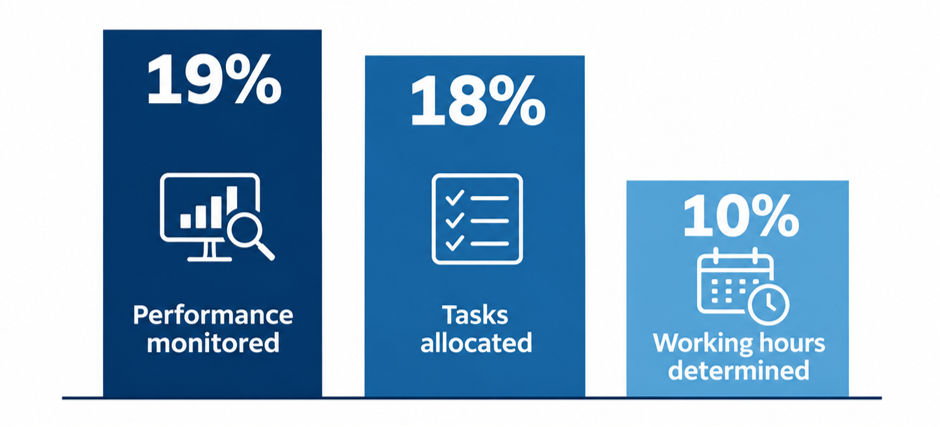
Source: Eurofound, Algorithmic Management in European Workplaces, 2026
When performance becomes data
AI can change the cadence of performance management. Rather than relying primarily on periodic or annual reviews, AI-enabled tools can support more continuous, data-informed feedback and coaching by analysing performance information, identifying patterns, and generating feedback or reports. Used appropriately, this can reduce administrative work for HR and managers and make feedback timelier.
At the same time, research from the International Labour Organization identifies three recurring weaknesses in AI systems used in HR: poorly aligned objectives, low-quality or biased data, and non-transparent programming. In performance management, this raises a fundamental question: what is the system being asked to recognize as good performance?
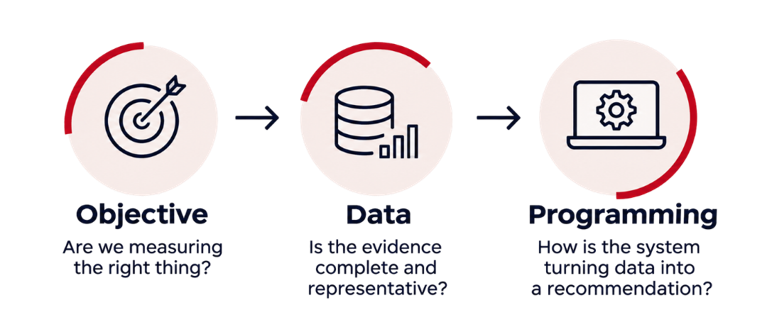
Source: International Labour Organization, AI in Human Resource Management: The Limits of Empiricism, 2025
Digital systems can capture quantifiable signals such as output, completion rates, work speed, response times, or adherence to targets. Yet valuable performance can also depend on judgement, collaboration, mentoring, problem-solving, and contributions that emerge over longer periods.
If the chosen measures are too narrow, a system may produce a consistent score that provides an incomplete view of performance. Fairness therefore depends on whether the measures selected reflect the work that genuinely matters and capture it appropriately across different roles and groups.
Gender is relevant because the performance data organizations already hold may itself contain differences. A 2026 study of 20,199 employees in a multinational company found statistically significant but small to negligible differences favouring men in ratings of performance and development potential. These varied according to factors including departmental gender composition and, partly, manager gender. EDGE Assessment data from more than 1,000 organizations, disaggregated by gender and level of responsibility, shows a pattern consistent with these findings. This reinforces the importance of examining historical performance data carefully before using it in AI-supported assessment.
AI recommendations can shape managerial judgement
Managerial involvement does not necessarily prevent an algorithm from influencing an assessment.
A 2025 study involving 775 managers across two controlled experiments found that managers’ performance ratings were affected by AI recommendations. The source of the recommendation interacted with whether managers were presented with a high or low initial anchor. As a result, an employee’s rating could differ even though the employee’s underlying performance had not changed.
AI-generated assessments and recommendations can shape managerial judgement and, in turn, an employee’s overall performance evaluation. This makes the quality, objectivity, and factual basis of the information used in the process particularly important. Humans need to agree objectives of AI tools and set the effective governance for them to provide meaningful outputs. Managers play an important role in setting context and reviewing the outputs. If done effectively, AI tools can be highly effective in helping to support fair workplace employment decisions.
Monitoring can change the experience of work
Performance monitoring also affects the conditions in which employees work.
The Eurofound research found that employees subject to algorithmic management reported higher job demands and were more likely to experience job strain. Of the three functions examined, performance monitoring was most consistently associated with poorer health and well-being. Among employees already experiencing job strain, algorithmic monitoring was associated with greater exhaustion and work-family conflict and lower work engagement.
This broadens the fairness question beyond the accuracy of a performance rating. Organizations also need to understand whether continuous measurement changes how employees experience their work and whether the measures being used create different outcomes for women and men.
From more measurement to better judgement
The objective should be to develop a fair and job-relevant understanding of performance, rather than simply increasing the amount of data available.
For organizations using AI-supported performance management, the evidence points to three connected questions: Are we measuring the aspects of performance that genuinely matter? Do ratings, recommendations, or monitoring outcomes differ between women and men? And are managers evaluating the evidence independently, or being anchored by what the system recommends?
More data can make work more visible. Fair performance management depends on whether that visibility produces better judgement.
The next article in this series will examine AI in professional development and training, including how technology can influence who gains access to learning and future opportunities.