

AI-enabled systems can support salary recommendations, starting-pay decisions, bonus allocation, market benchmarking, pay progression, and other compensation-related processes. Used effectively, they can help organizations analyse large volumes of information and support more consistent decision-making. Yet AI does not make the underlying data, assumptions, or recommendations inherently fair.
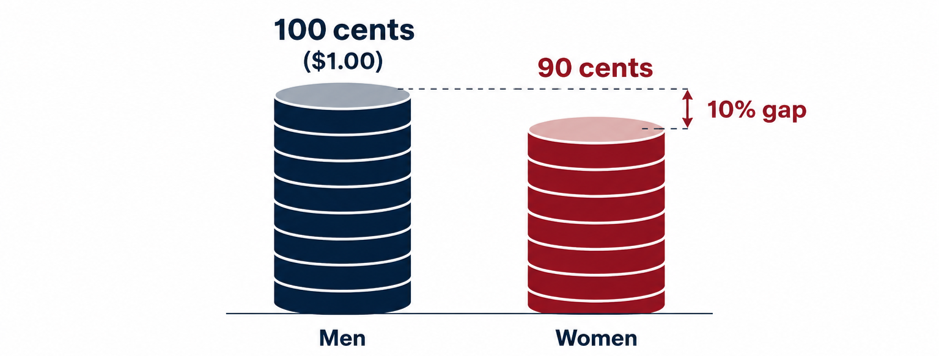
This matters against a backdrop of persistent inequality. In 2024, the median full-time working woman across OECD countries still earned around 10% less than her male counterpart, or approximately 90 cents for every dollar or euro earned by men.
Source: OECD, Pay Transparency in PROGRESS, 2026
Where AI can influence pay
Research shows that AI is changing how organizations assess performance and translate those assessments into reward decisions. Recent research on algorithm-based pay-for-performance systems describes how AI and generative AI can enable real-time adaptability, predictive analysis, customization, automated recommendations, and more sophisticated measurement within pay-for-performance systems.
At the same time, research from the International Labour Organization warns that the quality of AI-supported compensation decisions depends fundamentally on three factors: the objective the system is designed to achieve, the data it relies on, and how it is programmed. The ILO finds that poorly aligned objectives, biased or incomplete data, and opaque programming can distort decisions and reinforce existing inequalities.
For organizations, the key question is therefore not simply whether AI is involved, but where it enters the compensation process and what information influences the recommendation it produces.
When past inequality becomes a future recommendation
Compensation data reflects the labour market and organizational decisions that produced it.
If historical salaries contain gender differences, an AI tool trained on those salaries may learn those differences as part of the pattern it uses to generate future recommendations. Similar questions arise when systems rely on external market data. Market benchmarks can support competitive pay decisions, but they can also reflect occupational segregation, differences in progression, and existing gender pay gaps.
This matters because compensation decisions accumulate over time. A difference in starting salary can influence subsequent percentage-based increases. Market adjustments establish new reference points for future reviews. Bonus decisions affect total compensation. Repeated across compensation cycles, relatively small differences can become embedded in an employee’s longer-term pay trajectory.
A hidden layer in pay-equity analysis
AI can also make the causes of a pay gap more difficult to identify.
Pay-equity analysis typically examines whether differences in pay between women and men can be explained by objective and legitimate factors such as role, responsibility, tenure, or other relevant employee and workplace characteristics.
But if an AI-supported system has already influenced a starting salary, adjustment, bonus, or other compensation decision, that outcome becomes part of the organization’s pay data. A subsequent analysis may reveal an unexplained difference without making the role of the underlying technology immediately visible.
Organizations may therefore need to ask not only whether a gender pay gap exists, but also which decisions and systems may have contributed to creating or maintaining it.
As organizations face growing expectations and legal requirements to be more transparent about pay outcomes, understanding how those outcomes were produced becomes increasingly important. Where AI has influenced compensation decisions, organizations need to understand its role in shaping the pay data they may ultimately be required to disclose.
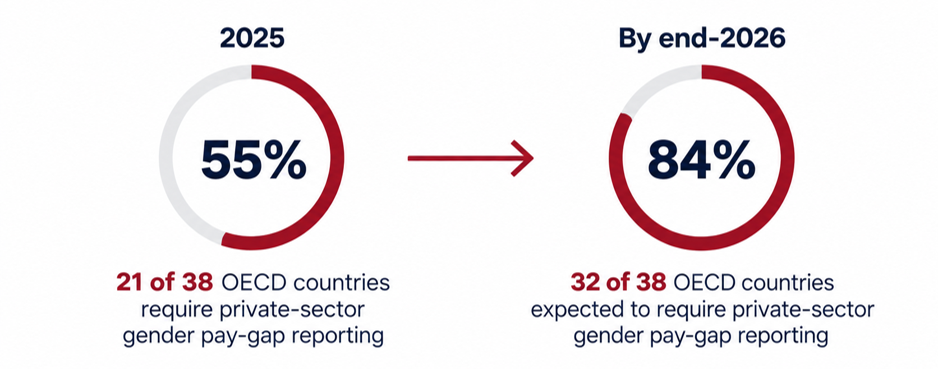
In September 2026, the OECD reported that 55% of OECD countries required private-sector gender pay-gap reporting, with this share expected to reach 84% by the end of 2026.
Source: OECD, Pay Transparency in PROGRESS, 2026
What should organizations consider?
Where AI influences compensation, organizations should consider whether they:
- know which pay decisions, recommendations, or benchmarks are influenced directly or indirectly by AI;
- assess whether historical pay data, market benchmarks, or other inputs could reproduce existing gender differences; and
- monitor compensation outcomes for women and men and investigate whether AI-supported decisions may be contributing to unexplained pay disparities.
AI may change how compensation decisions are informed, but the objective remains the same: ensuring fair pay for equivalent work.
Understanding the technology behind those decisions is increasingly part of understanding the pay gap itself.
The next article in this series will examine AI in performance management and employee monitoring, including how the data used to assess employees can influence workplace outcomes.