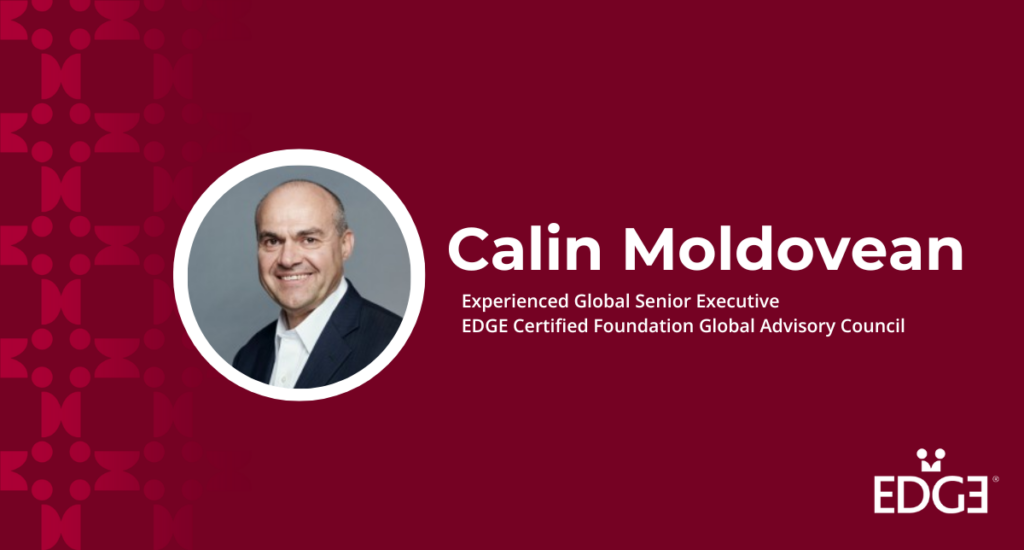
We are delighted to introduce Calin Moldovean, the newest member of the EDGE Certified Foundation Global Advisory Council.
Calin is a global senior executive with extensive leadership experience across strategy, operations, and business development in more than 50 countries. He brings deep expertise from the assurance and certification sector, having spent over 16 years at Intertek, an EDGE approved certification body, where he held senior global leadership roles across business assurance, food services, and regulatory services.
With this background, Calin brings valuable practical insight into independent verification, global standards, and leadership accountability to the work of the EDGE Certified Foundation.
In this interview, we hope you enjoy Calin Moldovean’s perspectives on what distinguishes the EDGE Standards, how leadership can drive meaningful progress on workplace fairness, and the role of independent, third-party verification in supporting credible and sustainable change.
You have been an active supporter of EDGE for the last 15 years, what do you believe makes the EDGE Standards and Certification stand out from other workforce equality related frameworks?
What made me an early believer in the EDGE approach, and what has sustained my support over the last 15 years, is its uncompromising focus on rigor, measurable outcomes, and real accountability. EDGE is not aspirational; it is a disciplined, process-driven framework that delivers tangible results. Over the years, I have seen firsthand the meaningful, lasting progress organizations achieve when they apply the EDGE methodology. Grounded in robust research and data, the EDGE Standards provide credibility and clarity in a space that too often relies on intent rather than evidence. It is precisely this rigor and impact that has led so many world-leading organizations to adopt and embed EDGE as a core part of their workforce equality strategy.
From your experience, how can leadership drive meaningful progress towards more diverse, fair, and inclusive workplaces?
Leadership plays a defining role in setting direction and driving meaningful change toward a more diverse, fair, and inclusive workplace. However, my experience as a business leader has shown that setting objectives alone is not enough. True progress requires leaders to fully embrace these principles and lead by example, starting with their own management teams. This means fostering regular, honest, and substantive conversations about progress, challenges, and outcomes. Throughout my career, I have been fortunate to work alongside diverse teams with a wide range of backgrounds, perspectives, and beliefs, which consistently led to better decision-making and a more balanced, effective leadership model. Actively celebrating progress and sharing best practices not only reinforces accountability but also accelerates momentum and encourages broader adoption across the organization.
Drawing on your extensive experience in the certification and assurance sector, how do you see the role of independent, third-party verification helping organizations advance workplace fairness and inclusion?
A third-party verification program adds a critical layer of credibility and rigor, helping to overcome internal skepticism and the perception that these initiatives “won’t work for us.” Independent assessment provides organizations with an objective view of their progress, equipping leadership with the evidence and confidence needed to drive meaningful change and continuous improvement. It also enables organizations to benchmark their performance against peers and gain valuable insights through engagement with independent assessors, turning verification into a catalyst for learning, accountability, and sustained impact.
If you are interested in more conversations with members of our Global Advisory Council and Academic and Scientific Council, and their insights on diversity, fairness, and inclusion, you can explore past interviews here:
- Prof. Iris Bohnet on workplace fairness.
- Anne Laure Humbert on gender and intersectionality through a data lens.
- Carolina Müller-Möhl on gender equality, compatibility of work and family life, education and economic development in Switzerland.
- Luis G. Solis on leadership and implementing policies that support women and diversity.
- Prof. Herminia Ibarra on careers transitions, and mentoring / sponsorship.
- Billie Jean King on championing DEI on and off the tennis court.